
How ERP Software Improves Foundry Production Management
Introduction
Monday’s pour plan lives on a whiteboard. Tuesday’s furnace breakdown never reached molding. Wednesday’s customer asks if their casings poured, and nobody can answer without walking the bay. That is foundry production without a system: metal moves, but management flies blind.
ERP software improves foundry production management by linking orders to melt schedules, heat numbers, pattern stock, shop-floor WIP, and dispatch, so production managers plan pours with data, not memory. This guide explains where ERP changes daily production work in Indian sand, jobbing, and investment foundries.
What foundry production management includes
Foundry production is not a single machine, it is a sequence:
- order release and grade confirmation
- pattern and mold readiness
- charge mix and melting
- pour and cooling
- shakeout, fettling, and finishing
- QC, machining handoff, and dispatch
Each step has different bottlenecks. ERP makes WIP visible between them so you do not promise dispatch while castings still sit in fettling.
Broader operations context: ERP software improves operations in casting foundries and challenges facing the foundry industry and how ERP solves them.
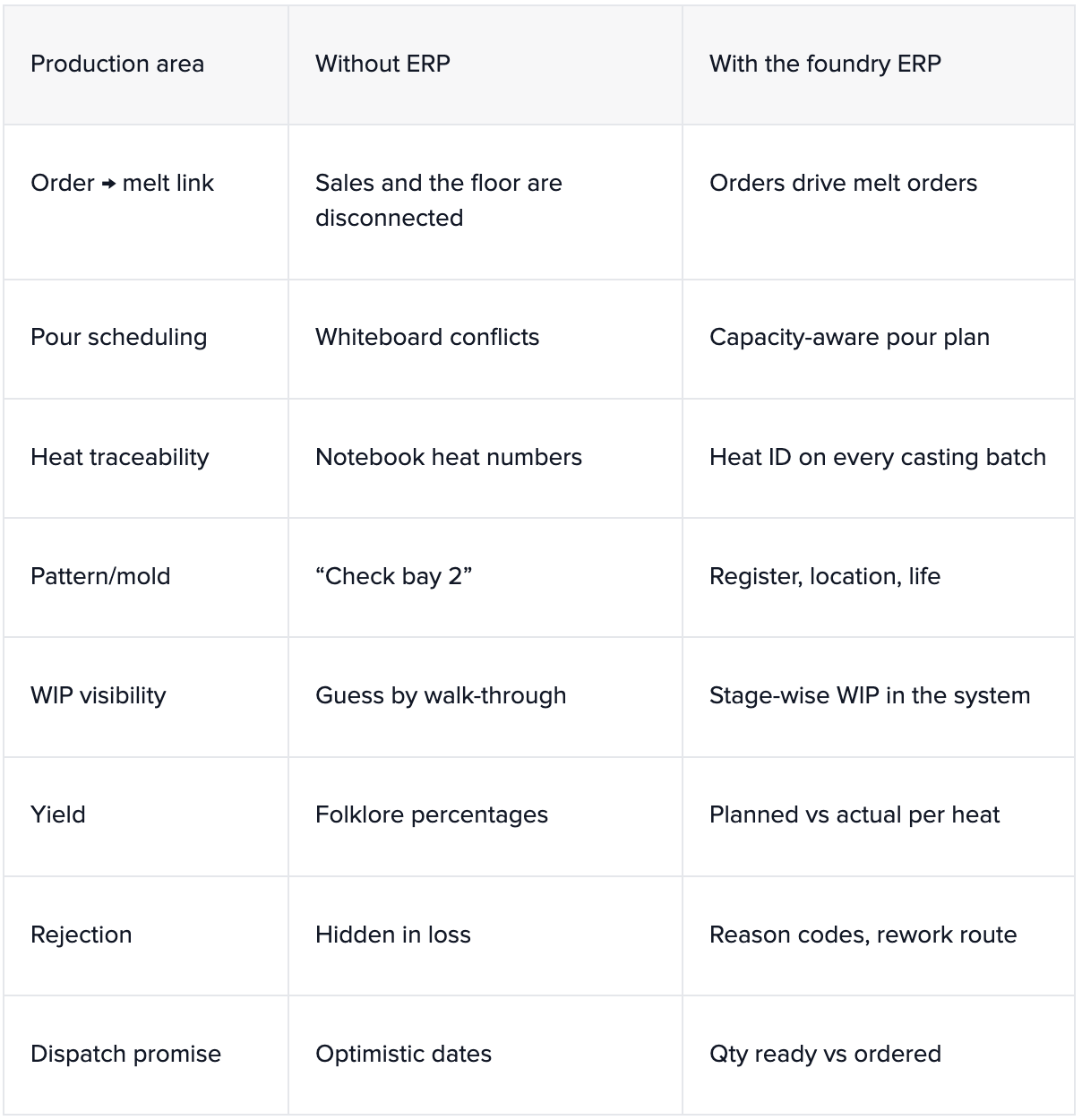
Manual production vs ERP-managed foundry production
Seven ways ERP improves foundry production
1) Melt orders tied to customer demand
ERP releases melt orders from sales or forecast, not from whatever the furnace operator remembers. Each melt lists grade, target weight, patterns to pour, and linked customer order lines. Production chases schedule, not firefighting.
2) Pour planning and furnace capacity
Jobbing foundries juggle grades, box sizes, and deadlines. ERP sequences pours by furnace capacity, ladle size, and mold readiness, reducing wrong-sequence remelts and idle furnace time. Cast iron depth: ERP helps cast iron foundries improve efficiency.
3) Charge mix control per heat
Approved recipes per grade log what entered each heat. Scrap returns to melting with traceability. Purchasing and production share alloy stock truth, critical when scrap prices swing.
4) Heat numbers and production traceability
Every production batch carries a heat number linked to QC, customer order, and dispatch. Field failures become a search, not a debate, which matters for automotive and pump supply chains. Related: ERP for metal fabrication downstream.
5) Pattern and mold register
Lost patterns delay pours. ERP tracks pattern location, repair history, and shots remaining, so molding does not start a job the pattern floor cannot support.
6) WIP and stage-wise production tracking
Castings move through pour, cool, shakeout, fettling, and shot blast. ERP shows WIP by stage so production meetings count pieces, not anecdotes. Manufacturing patterns: how ERP transforms manufacturing operations and best manufacturing ERP software.
7) Yield, rejection, and production KPIs
ERP captures planned vs poured weight, rejection reason codes, and return scrap to melt. Managers see yield by product line, shift, or customer part, and stop repeating the same defect. QC ties to heat or lot for audit-ready foundry production records.
Production KPIs ERP should surface
- on-time pour vs melt order schedule
- furnace utilization and idle time
- yield % by grade and pattern
- rejection rate and top reason codes
- WIP days by stage (fettling backlog)
- order fill rate (good castings shipped vs ordered)
- energy or cost per ton melted (when furnace logs are captured)
Without baselines, production meetings stay subjective.
Foundry production modules in a modern ERP stack
- Sales / planning: order release to production
- Melt orders & pour plan: furnace schedule, grade grouping
- Manufacturing work orders: molding through fettling steps
- Inventory: scrap, alloys, cores, finished castings
- QC: inspection linked to heat or batch
- Dispatch: shipped qty tied to heat and invoice
- Finance: GST billing aligned to good castings shipped
Platform options: Odoo software complete guide, why Odoo ERP delivers better ROI for manufacturers, Odoo vs SAP for manufacturing. Finance bridge: Tally integration software.
Phased ERP rollout for foundry production
- Discovery: map melt → pour → fettle → dispatch; define heat-number rules.
- Master data: items, grades, patterns, BOMs, opening WIP.
- Phase 1: melt orders, pour logging, basic WIP.
- Phase 2: yield, rejection codes, QC checkpoints.
- Train supervisors first: melt deck adoption sets tone.
- Go-live + hypercare: parallel run one week on live pours.
Timeline: often 6–14 weeks for focused SME scope, see ERP implementation guide and how to choose an Odoo ERP implementation company in India.
Common production mistakes ERP exposes (and fixes)
- pouring before pattern or core is ready, schedule shows dependency
- grade change without furnace prep time, sequencing rules enforce gaps
- fettling backlog invisible until dispatch slips, WIP by stage flags early
- rejections not coded, true yield stays hidden
- dispatch qty ≠ poured good qty, system ties shipment to QC-pass stock
Efficiency lens: how tailored ERP solutions improve business efficiency. Downstream machining: machine shop management software.
Where Nakshatra fits
Nakshatra Solutions implements ERP for foundry production management, melt orders, heat tracking, pattern control, pour planning, yield analysis, and shop-floor training, on Odoo and custom stacks built for Indian casting plants. With 24+ years and domain teams for foundry metallurgy and ERP configuration, we model software around your melt floor, not a generic manufacturing template.
Your vision. Our solution. Delivered end-to-end.
FAQ: Foundry production and ERP
How does ERP improve foundry production?
It links orders to melt schedules, heat numbers, WIP, yield, and dispatch on one system.
What is foundry production management?
Planning and executing melt through finishing so orders ship on time at spec and yield.
Can Odoo manage foundry production?
Yes, with foundry-specific customization for heat logic, melt orders, and yield.
What to implement first?
Melt orders, pour logging, and WIP, then yield and advanced QC.
How long to go live?
Often 6–14 weeks phased for SME foundries.
How does Nakshatra help?
Foundry ERP implementation and AMC, visit Nakshatra Solutions
Closing: production management is where margin is won or lost
Foundry production runs on metal, time, and yield, not on whether the whiteboard was updated. ERP software gives production managers melt orders, heat traceability, WIP truth, and rejection data in one place so pours and promises stay aligned.
Ready to tighten foundry production control? Contact Nakshatra Solutions for a requirement study and phased plan built for your melting and molding workflow.
.svg)