


ERP Solutions for Saree Wholesalers and Textile Distributors
Introduction
A retailer returns half the bale because the border shade does not match the body lot. Your godown register shows 840 pieces of design SR-4421, but 200 are already on verbal hold for three agents. Purchase booked “wedding silk” at one rate; sales invoiced a different collection code at month-end. That is daily life for saree wholesale dealers when inventory runs on registers, WhatsApp lists, and memory.
This guide explains why saree wholesalers and textile distributors need ERP built for design-led trading, which modules and workflows matter for saree wholesale dealers, and how Indian trading firms connect godown, agent sales, schemes, and GST without spreadsheet chaos.
What makes saree wholesale different from generic trading
Saree distribution is not carton-pick FMCG. Saree wholesale dealers trade in:
- Design catalogs: design numbers, borders, blouse piece options, collection tags
- Color and shade lots: same design, different dye batch; mixing shades breaks retail display
- Piece-wise inventory: count in pieces and sets, not only weight or rolls
- Seasonal collections: wedding, festive, summer cotton, office wear cycles
- Agent and salesman orders: field teams booking against live stock
- Scheme and bulk pricing: slab discounts, festival offers, retailer tiers
- Multi-branch godowns: Surat, Kolhapur, Chennai, Delhi hubs serving regional retailers
- Sample pieces: swatches and hangers tracked separately from sellable stock
- Credit-led B2B sales: retailer limits, ageing, and follow-up
ERP for saree trading must model those attributes, or your team reverts to parallel Excel and agent notebooks.
Channel context: wholesaler vs distributor in supply chains, ERP for fabric distributors and textile supply chains, and what is ERP in supply chain management.
Top challenges for saree wholesale dealers (and ERP responses)

Core ERP modules for saree wholesalers and textile distributors
- Inventory / warehouse: design, shade, piece count, godown, bin
- Purchase: weaver, mill, and importer PO; GRN against design
- Sales: retailer orders, agent booking, pick list, dispatch
- Pricing & schemes: slabs, festivals, customer category
- CRM / agent management: visit log, target, commission basis
- Branch transfer: move bales between showrooms and godowns
- Accounting / GST: invoices, credit note, e-invoice, ageing
- Reports & MIS: fast-moving designs, dead stock, agent performance
Warehouse depth: what is warehouse management and why it matters and warehouse inventory management system buyer's guide.
1) Design catalog and attribute management
Saree wholesale dealers think in design numbers, not generic item codes. ERP stores design ID, fabric type (silk, cotton, georgette, linen), work type (banarasi, bandhani, printed), border style, blouse piece flag, and collection (wedding, daily, festive).
Sales searches “SR-4421 maroon banarasi” and sees pieces by godown, not a flat total that hides branch reality. New collections launch without duplicating masters or breaking last season’s reports.
2) Shade, lot, and piece-wise tracking
Same design in two dye lots is two sellable lines for retailers who display six pieces together. ERP ties each lot to purchase GRN and sales dispatch, so returns land on the correct shade and stock ageing reports show slow lots before they become write-offs.
Fabric-first cousins track rolls and meters; saree dealers track pieces. Your ERP must default to piece UoM with optional weight for silk purchase, see also wholesale fabric distributor ERP when you trade both fabric and finished sarees.
3) Agent, salesman, and retailer order workflows
Field agents book orders on tablets or phones at retailer shops. Without ERP, two agents promise the same 50 pieces. With ERP, orders reserve stock, or show backorder with expected inward date from purchase.
Commission and target tracking live beside orders so management sees agent-wise revenue, not only month-end guesswork. Similar wholesale patterns: pharmacy wholesale distributors and uniform distributors.
4) Multi-branch godowns and inter-transfer
Surat holds bulk; Mumbai showroom holds fast movers; Kolhapur serves western Maharashtra retailers. ERP records branch transfers with in-transit status, so Surat does not sell stock already on a truck to Pune.
Consolidated leadership view shows design availability company-wide; branch managers see only their godown pick lists.
5) Scheme pricing, bulk slabs, and festival offers
Saree trading runs on quantity slabs, “50+ pieces at X, 100+ at Y”, and time-bound festival schemes. ERP applies rules at invoice time so counter staff cannot accidentally grant the wrong discount.
Finance audits scheme utilization by collection and customer tier, protecting margin during high-volume Diwali weeks.
6) Purchase from weavers, mills, and job work
Inward flow may come from weavers, powerloom units, embroidery job workers, or importers. ERP links PO → GRN → design master update → sellable stock. Job-work challans track pieces sent for border work or fall pico, so WIP does not disappear between units.
Nakshatra’s textile segment experience from Nakshatra Solutions includes yarn, fabric, and garment workflows, adapted for saree catalog complexity.
7) Sample management
Showroom hangers and agent sample bags are inventory too, often written off informally. ERP marks sample locations and statuses so sellable stock stays clean and write-offs are documented.
8) Credit control and retailer ageing
B2B saree trade is credit-heavy. ERP enforces credit limits at order entry, shows outstanding ageing before dispatch approval, and flags chronic defaulters, so sales enthusiasm does not ship into uncollectable debt.
9) GST, HSN, and e-invoice compliance
Textile HSN mapping errors trigger audit pain. ERP item masters carry validated HSN, GST rate, and unit, flowing to e-invoice in Tally Prime or native Odoo billing. Verify codes with how to check HSN code in Tally during master data setup.
Many saree wholesale dealers keep Tally for statutory books while running operations in Odoo, via Tally integration software and ERP systems in accounting.
10) MIS dashboards for saree business owners
Owners need more than stock ledgers:
- fast-moving designs and colors this month
- dead stock by collection and branch
- agent-wise sales and margin
- purchase vs sales gap before festival peak
- dispatch OTIF to top retailers
ERP dashboards turn godown data into decisions, which collection to push, which design to discontinue, which agent needs stock reallocation.
Manual trading vs ERP for saree wholesale dealers
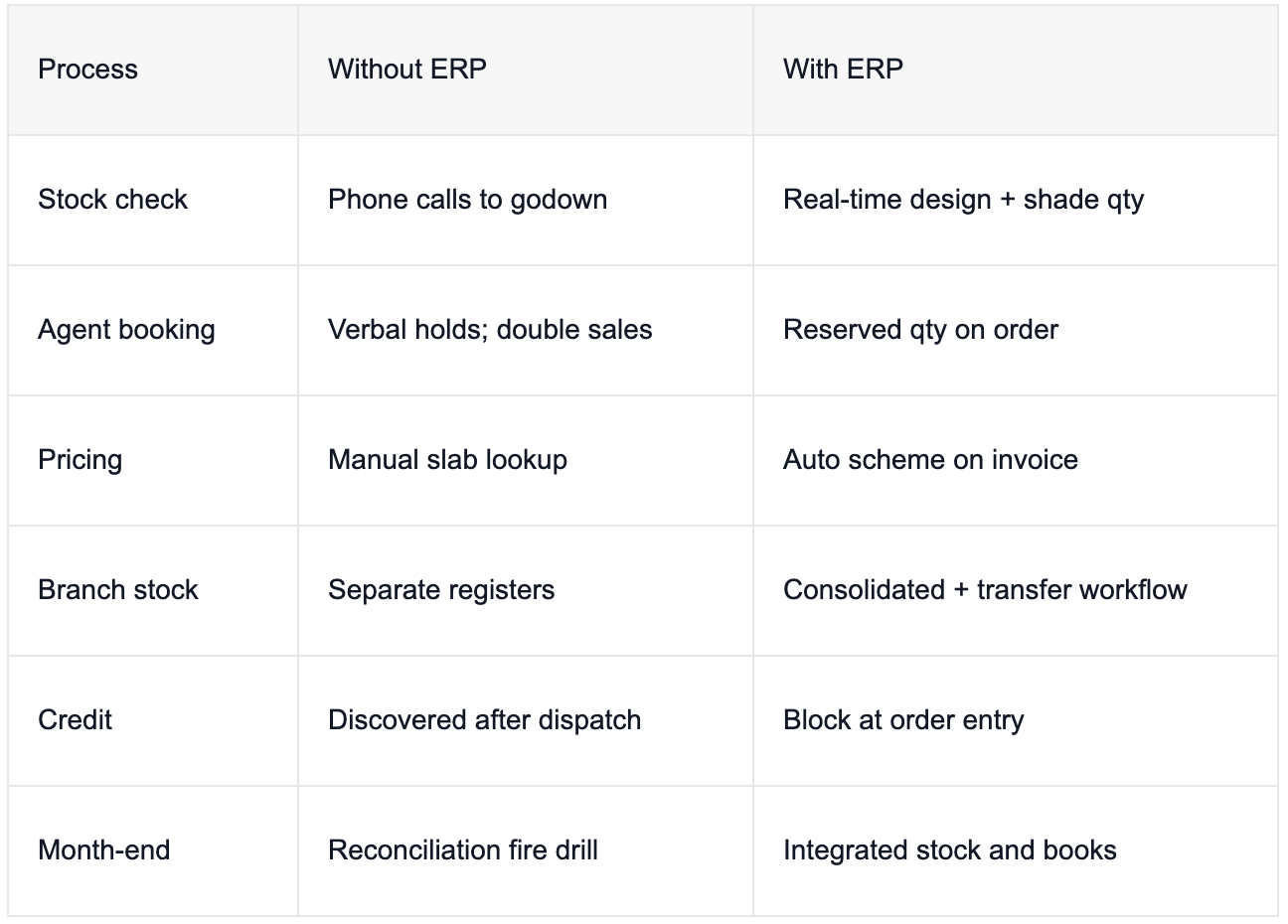
Is Odoo a good fit for saree wholesalers?
Yes, for many Indian saree wholesale dealers and textile distributors. Odoo delivers inventory, multi-warehouse, purchase, sales, CRM, accounting, and customization at SME economics, especially versus SAP or Oracle for trading houses.
Compare: Odoo software: complete guide for growing businesses, best ERP software in India, why Odoo ERP delivers better ROI, and how tailored ERP solutions improve business efficiency.
Generic ERP without textile configuration fails on design attributes, choose a partner who configures for trading, not only manufacturing BOMs.
Implementing ERP for saree wholesale dealers (practical steps)
- Discovery: map purchase, godown, agent sales, showroom, dispatch, returns.
- Design master cleanup: design IDs, colors, HSN, collections, dedupe before migration.
- Configure inventory rules: piece UoM, lots, branches, sample locations.
- Sales & pricing: retailer tiers, schemes, credit limits.
- Pilot branch: one godown before company-wide cutover.
- Train agents and godown staff first: they set adoption tone.
- Integrate finance: Odoo accounting or Tally bridge; validate first festival close.
- AMC: new collections, reports, GST updates each season.
Phased rollout: ERP implementation guide. Partner selection: how to choose an Odoo ERP implementation company in India, ERP customization in Kolhapur, and Odoo partner in Pune.
Common mistakes when saree wholesalers adopt ERP
- loading ERP without cleaning design and color masters
- treating sarees as generic SKU without shade lots
- skipping agent reservation logic, double bookings continue
- no credit rules, ERP becomes billing-only
- ignoring sample and damaged stock locations
- big-bang go-live before one festival season pilot
Where Nakshatra fits
Nakshatra Solutions implements ERP for saree wholesale dealers and textile distributors, with design-wise inventory, multi-branch godowns, agent workflows, scheme pricing, GST compliance, and optional Tally integration. With 24+ years serving Indian businesses across 60+ sectors, including textile and garments, we configure Odoo and custom ERP around how saree traders actually buy, stock, and sell, not around a generic product chart.
From Surat and Kolhapur trading hubs to multi-city distributors, we deliver discovery, build, training, go-live, and AMC as one accountable partner. Your vision. Our solution. Delivered end-to-end.
FAQ: ERP for saree wholesale dealers
Why do saree wholesale dealers need ERP?
Design complexity, shade lots, agent orders, multi-branch stock, and credit-led B2B sales break spreadsheet control.
Can ERP track sarees by design and color?
Yes, with design attributes, lot or shade, piece count, and location per godown.
Is Odoo suitable for saree wholesalers?
Yes for many SMEs, with textile customization and an experienced implementation partner.
Can we keep Tally for accounting?
Yes. Many dealers run operations in Odoo and sync to Tally for statutory books.
How long does implementation take?
Often 4–12 weeks for focused trading scope, phased by branch or module.
How does Nakshatra help saree wholesale dealers?
End-to-end Odoo and custom ERP for textile trading, visit nakshatrainfo.com.
Closing: ERP turns saree trading chaos into catalog control
Saree wholesale dealers win on design breadth, shade accuracy, agent reach, and festival readiness, not on who has the most registers. ERP connects godown, sales floor, agents, and finance so you promise retailers what you can pick, price schemes correctly, and close months without stock surprises.
Ready to modernize saree wholesale operations? Contact Nakshatra Solutions for a requirement study and phased ERP plan built for your design catalog and branch network.
.svg)